Flagship Exterior Aluminium Windows & Doors
Defining High-Performance Architectural Fenestration Sourcing from China
In the global architectural landscape, selecting an authoritative China top aluminium outside doors manufacturer & exporter requires evaluating far more than raw unit prices. Modern envelope engineering demands rigorous metallurgical compliance, precision thermal barrier integration, dynamic wind-load resistance, and certified water tightness. As commercial developers, general contractors, and architectural specifiers design zero-carbon, high-rise, and luxury residential projects, Chinese manufacturing ecosystem leaders—such as Meric Window Systems—have transitioned from high-volume suppliers into bespoke engineering partners.
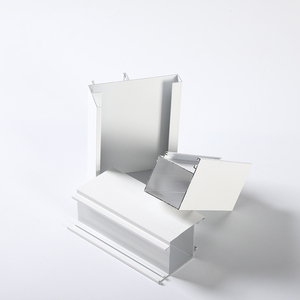
The structural integrity of exterior aluminium door systems relies on high-grade profile extrusion. Premier Chinese manufacturers utilize primary 6063-T5 and 6061-T6 aluminium alloys, engineered with wall thicknesses ranging from 2.0mm to 3.0mm for heavy-duty sliding, bi-folding, and swing doors. By pairing advanced structural profiles with multi-cavity Polyamide (PA66 GF25) thermal break strips, modern exterior doors eliminate thermal bridging, achieving total system thermal transmittance values ($U_{w}$) as low as $0.8 \text{ W/m}^2\text{K}$ to meet Passivhaus standards across North America, Europe, and Australia.
Metallurgical Superiority
Extruded strictly from 100% pure primary aluminium ingots (6063-T5/T6 alloy). High tensile strength ensures resistance to cyclic wind pressure exceeding 5000 Pa without structural deflection.
Thermal Barrier Engineering
Integrated Technoform PA66 GF25 polyamide insulation strips paired with multi-cavity foam-filled profiles, dramatically curtailing conductive heat flow in extreme climate zones.
Global Compliance Testing
Certified against rigorous international fenestration standards, including Australian AS2047/AS1288, American AAMA/WDMA/CSA, and European CE/EN 14351-1 testing protocols.
In-Depth Analysis of Architectural Outside Door Categories
Selecting the appropriate door system requires a precise match between architectural intent, spatial layout, and environmental exposure. Top Chinese exporters manufacture diverse, customized outside door configurations engineered to solve complex building envelope challenges.
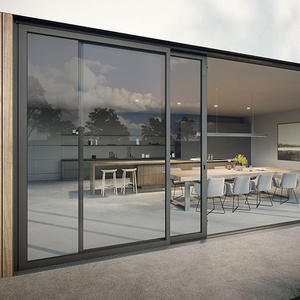
1. Minimalist Ultra-Narrow Sightline Sliding Systems
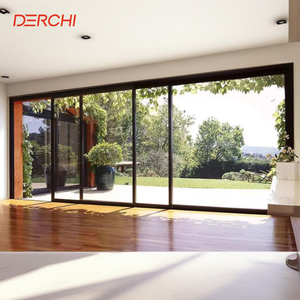
Minimalist sliding doors feature ultra-slim interlock sightlines (down to 20mm visible width) that maximize daylighting and uninterrupted visual connections to exterior landscapes. The structural deadload of heavy double or triple insulated glass units (IGUs) is transferred directly onto stainless steel bottom tracks via heavy-duty tandem rollers.
Key Spec: Up to 600 kg panel capacity with motorized or whisper-quiet manual sliding mechanisms. Ideal for coastal luxury villas, penthouses, and high-end resort hospitality spaces.
2. Lift and Slide Patio Doors (Heavy-Duty Engineering)
Designed for harsh outdoor environments, Lift & Slide systems utilize a mechanical gear system that elevates the door sash off its EPDM weather seals during operation, enabling massive panels to slide with minimal friction. When locked, the sash lowers onto continuous multi-point gaskets.
Key Spec: Provides class-leading air tightness (Class 4 / EN 12207) and water penetration resistance (Class 9A / EN 12208), making it the gold standard for storm-prone regions.
3. Thermally Broken Bi-Folding (Bifold) Exterior Doors
Bi-fold systems maximize opening flexibility by allowing up to 95% of the structural opening to be clear. Engineered with top-hung stainless steel trolley tracks and bottom guide rollers, these systems ensure frictionless folding across multi-panel configurations (e.g., 3+1, 5+1, 7+0 setups).
Key Spec: Concealed hinge options, low-threshold flush tracks for barrier-free accessibility, and integrated anti-finger-pinch rubber seals.
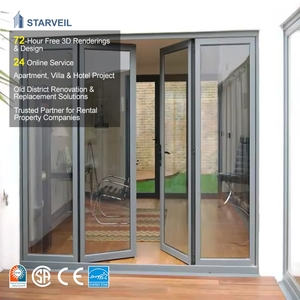
4. Crittall-Style French Entrance & Swing Glass Doors
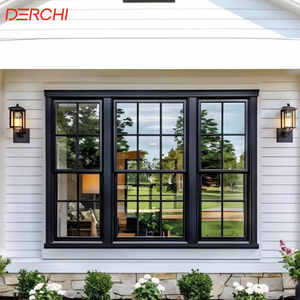
Combining industrial heritage aesthetics with modern thermal insulation, Crittall-style exterior aluminium swing doors utilize custom glazing bars (muntins) and narrow-profile frame extrusions. Fitted with multi-point lock systems (Siegenia, Hoppe, or GU hardware).
Key Spec: Thermally broken extruded profiles combined with dual-seal EPDM gaskets to maintain vintage charm without compromising operational energy efficiency.
Comparative Technical Performance Matrix for Exterior Aluminium Doors
The table below provides direct structural and thermal metrics for technical evaluation during product selection and project specification.
| Door System Category | Visible Sightline (Interlock) | Max Panel Dimensions (W×H) | Thermal Transmittance ($U_w$) | Acoustic Insulation ($R_w$) | Water Tightness Rating |
|---|---|---|---|---|---|
| Ultra-Narrow Sliding | 20 mm – 25 mm | 3000 × 4000 mm | 1.0 - 1.4 W/m²K | 38 dB - 42 dB | 450 Pa - 600 Pa |
| Lift & Slide Heavy Duty | 45 mm – 65 mm | 3200 × 3500 mm | 0.8 - 1.2 W/m²K | 40 dB - 45 dB | 700 Pa - 1050 Pa |
| Exterior Bi-Fold System | 110 mm – 138 mm (Stile Pair) | 1200 × 3200 mm (Per Sash) | 1.2 - 1.6 W/m²K | 35 dB - 40 dB | 400 Pa - 600 Pa |
| Thermal Swing French Door | 68 mm – 85 mm | 1100 × 2800 mm (Per Leaf) | 1.1 - 1.5 W/m²K | 36 dB - 42 dB | 500 Pa - 750 Pa |
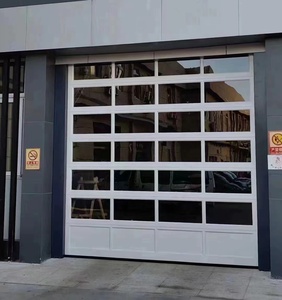
| Commercial Glass Garage Door | Horizontal Rail 60 mm | 6000 × 3000 mm (Full Opening) | 1.8 - 2.4 W/m²K | 28 dB - 34 dB | 250 Pa - 400 Pa |
Industry Development Trends Shaping Exterior Aluminium Fenestration
Driven by stringent energy compliance laws, carbon neutrality mandates, and evolving architectural tastes, the global production of exterior aluminium doors is undergoing rapid technological shifts. Lead manufacturing hubs in China are pioneering four pivotal structural innovations:
1. Integration of Structural Silicon & Bonded Glass Units
Traditional doors rely on mechanical beads and gaskets to retain glass. The industry trend is moving toward structural silicone adhesive bonding (Structural Glazing). By bonding double/triple glass IGUs directly to the aluminum sash profile, the glass becomes a load-bearing element. This increases frame rigidity, allowing for slimmer profiles, improved wind-load distribution, and eliminated sagging over long-term operation.
2. Concealed Motorization & Smart Automation Integration
High-end architectural projects increasingly mandate motorized opening mechanisms integrated directly into the door head frame or floor trench. Modern Chinese exporters incorporate brush-less DC drive systems, electromagnetic locks, and smart home IoT protocols (KNX, Zigbee, RS485). Doors can be operated via smartphone applications, wall keypads, anti-pinch infrared safety sensors, or automated rain/wind monitoring networks.
3. Ultra-Low U-Value Aerogel & Vacuum Insulated Glass (VIG)
To eliminate heavy triple-pane units, advanced manufacturers are embedding nanoporous aerogel thermal insulation inside aluminum profile break cavities, combined with Vacuum Insulated Glass (VIG). VIG features a 0.3mm vacuum gap between glass panes, achieving thermal insulation superior to solid brick walls ($U_g \le 0.4 \text{ W/m}^2\text{K}$) while remaining ultra-lightweight.
4. Advanced Surface Coatings (Fluorocarbon PVDF & Anodizing)
Exterior doors must withstand aggressive environmental exposure, including salt spray in coastal regions and high UV radiation in desert areas. Modern factories utilize 3-coat/3-bake PVDF (Polyvinylidene Fluoride) fluorocarbon coatings (AAMA 2605 compliant) and hard anodizing treatments (up to 25 microns thickness). These finishes guarantee color stability, weatherability, and corrosion resistance for 25 to 30 years without chalking or peeling.
Future Procurement Trends for International Buyers & Importers
Global building product procurement is shifting away from fragmented component sourcing toward integrated, factory-assembled envelope packages. Overseas buyers are adapting their supply chain strategies around three primary transformation pillars:
BIM & Digital Twin CAD Integration
Leading developers demand fully configured Building Information Modeling (BIM) files (.RVT, .IFC format) prior to extrusion. Top Chinese factories utilize 3D parametric CAD modeling software to simulate wind deflection, thermal performance, and interface flashing details before manufacturing begins, reducing on-site structural adjustments.
Direct-from-Factory Modular Packaging
To combat rising labor costs in target export destinations (such as Australia, the USA, and Western Europe), buyers are requesting pre-glazed, unitized, or modularly knock-down (KD) packed door systems. Each component arrives pre-drilled, labeled, and color-coded to correspond directly with structural floor plans for rapid installation.
Full Supply Chain Traceability & ESG Compliance
Institutional investors require Environmental Product Declarations (EPDs) and low carbon footprint documentation. Exporters in China are migrating toward certified green aluminum billets processed using hydroelectric power, alongside full material traceability for stainless steel hardware, rubber gaskets, and Low-E glass units.
Frequently Asked Procurement Questions
When importing outside doors, verify performance test reports for wind load resistance, air tightness, and water tightness. For Australia and New Zealand, ensure full certification under AS2047 and AS1288 (using NATA-accredited test facilities). For the North American market, verify AAMA/WDMA/CSA 101/I.S.2/A440 and NFRC thermal ratings. For Europe, ensure CE marking under EN 14351-1. Additionally, factory management should hold ISO 9001 quality management standards.
Aluminium is a highly conductive material ($K \approx 200 \text{ W/m}\cdot\text{K}$). Non-thermal break profiles transfer heat rapidly, causing heavy energy loss, indoor climate instability, and condensation buildup on frame surfaces during cold or humid seasons. A thermally broken aluminum profile splits the interior and exterior aluminium extrusions using a low-conductivity Polyamide (PA66 GF25) strip ($K \approx 0.3 \text{ W/m}\cdot\text{K}$). This mechanical barrier reduces total heat transfer through the frame by up to 70%, lowering HVAC energy consumption.
For exterior doors, system longevity depends heavily on hardware durability. Top exporters offer premium European hardware options, including Siegenia, Hoppe, Roto, and GU (Germany), as well as CMECH (USA) and top-tier domestic brands like Kin Long and KSS. Multi-point locking mechanisms lock the sash into the outer frame at 3 to 5 separate points simultaneously, improving forced entry protection, frame alignment, and perimeter seal compression.
Export-ready packing protocols involve multiple protective layers. Profiles are wrapped in protective anti-scratch surface film, followed by corner foam protectors and heavy-duty bubble wrap. Glazed door panels are packed inside custom-built, fumigation-free plywood crates or heavy-duty steel transport A-frames equipped with internal rubber dampening strips. Desiccant packs are introduced inside crates to prevent moisture condensation during oceanic transit.
To provide a precise engineering quote, your supplier requires: (1) Architectural CAD drawings or window/door opening schedules showing dimensions and quantity; (2) Preferred opening configuration (sliding, bi-fold, lift & slide, or swing); (3) Glass specifications (e.g., 6mm Low-E + 12Ar + 6mm Tempered); (4) Surface finish type and RAL color code; and (5) Specific wind pressure requirements or job-site geographical location for structural load calculation.
Partner with China's Premier Aluminium Door Engineering Factory
Whether you are managing a luxury private villa development, a commercial hotel resort project, or a high-volume import distribution business, our engineering team provides complete technical drawing reviews, custom extrusion profiles, and certified manufacturing.