
Comprehensive Technical Sourcing Guide: Architectural & Industrial Aluminium Roller Doors
As modern architectural design and logistics infrastructure demand higher structural integrity, thermal regulation, and operational automation, the global market for **aluminium roller shutter doors** has shifted away from traditional single-skin galvanized steel doors toward high-tensile, insulated extruded aluminum profile systems. Sourcing directly from top-tier Chinese aluminum roller door manufacturers provides global buyers—including commercial contractors, real estate developers, and door distributors—unmatched economies of scale, customized metallurgy, and strict adherence to international safety standards (CE, AS2047, NFRC, ASTM, and EN standards).
1. Metallurgical Profiles & Structural Engineering Specifications
The core structural capability of an aluminum rolling door relies on the geometry of its slats and the chemical composition of the aluminum extrusion. Leading Chinese factories utilize primary ingot aluminium extruded under press tonnages ranging from 1,000 to 5,000 metric tons.
- Alloy Tempering (6063-T5 vs 6063-T6): 6063-T5 is standard for residential window shutters and lightweight commercial roll-ups due to its smooth surface finish and superior anodizing quality. For heavy-duty industrial warehouses, wide-span garage openings (over 6 meters wide), and hurricane-prone coastal regions, 6063-T6 temper is specified, providing a minimum tensile strength of 205 MPa and yield strength of 170 MPa.
- Slat Geometry & Foam Infill: Slat heights typically range from 39mm, 45mm, 55mm, 77mm to 120mm heavy-duty double-skin industrial profiles. High-density rigid Polyurethane (PU) foam injection provides structural anti-flex rigidity while acting as a barrier against thermal transfer and structural vibration.
- Surface Coating Performance: Advanced powder coating lines apply AkzoNobel or PPG Qualicoat-certified fluorocarbon (PVDF) or architectural polyester coatings. These coatings undergo 3,000-to-5,000-hour accelerated Salt Spray Tests (ASTM B117), ensuring zero blistering, cracking, or color fading in aggressive marine environments.
2. Structural Wind Load Resistance & Security Standard Compliance
Evaluating wind pressure performance is vital when specifying roller doors for wide-span commercial bays or high-rise building parking facilities. Engineering calculations adhere to EN 12424 (European Standard for Industrial, Commercial and Garage Doors) and AS/NZS 4505 (Australian Standard for Garage Doors).
| Performance Standard | Classification Level | Wind Pressure Rating (Pa) | Equivalent Wind Speed | Recommended Sourcing Application |
|---|---|---|---|---|
| EN 12424 Wind Class | Class 2 | 450 Pa | ~98 km/h (Strong Gale) | Residential Garage & Storefronts |
| EN 12424 Wind Class | Class 3 | 700 Pa | ~123 km/h (Storm Force) | Standard Commercial Warehouses |
| EN 12424 Wind Class | Class 4 / Class 5 | 1000 Pa - 1600 Pa+ | 145 - 185+ km/h (Hurricane) | Industrial Logistics & Coastal Bays |
| Miami-Dade (TAS 202) | Impact Passed | Up to 3500 Pa Design Load | > 240 km/h (Category 4/5) | Florida/Caribbean Severe Weather |
| EN 1627 Burglar Test | RC2 / RC3 Rating | Static & Dynamic Load Test | Manual Tool Attack Resistant | High-Value Retail & Financial Vaults |
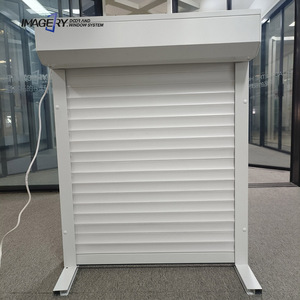
To resist heavy wind pressures without blowing out of side tracks, wide doors are equipped with **heavy-duty aluminum end-lock clips** riveted to alternate slat ends, which key into continuous internal lips extruded directly within the deep guide tracks.
3. Smart Automation, Tubular Motors & Safety System Integration
Modern commercial and residential roller shutters rely on intelligent drive units and real-time safety telemetry. Primary motorized roller door systems manufactured in China incorporate three main categories of automation:
- AC Tubular Motors (230V / 120V): Fitted internally within the barrel axle for space-saving operation. Torque outputs range from 10 Nm for residential windows up to 300 Nm for large commercial rolling shutters. Features include thermal overload protection, mechanical or electronic limit switches, and manual crank override (HK) for power outages.
- Industrial Side Drive Motors (380V Three-Phase / 220V Single-Phase): External direct-drive or chain-drive motors for high-frequency industrial usage (up to 100+ cycles per day). Equipped with soft-start / soft-stop variable frequency drives (VFD) to minimize mechanical shock and mechanical wear.
- Safety Sensor Networks: Compliance with EN 12453 safety standards requires dual safety systems: non-contact photoelectric safety beams across the door opening, paired with an opto-electronic bottom safety edge integrated inside the hollow bottom rubber profile that instantly reverses movement upon contacting an obstruction.
4. Future Global Procurement Trends (2025–2030)
Global procurement metrics show a significant pivot toward energy efficiency, smart city connectivity, and sustainable manufacturing practices:
- Photovoltaic Integrated Slat Systems (BIPV): Next-generation architectural roller shutters feature micro-flexible solar cell strips mounted directly on outer slat curves, charging localized energy storage battery banks to power door automation off-grid.
- AI-Connected Predictive Maintenance: Smart IoT control boxes equipped with RS485 / Modbus / Zigbee protocols transmit vibration telemetry, temperature fluctuations, and cycle counts to building management systems (BMS), alerting facilities teams before component wear causes downtime.
- Decarbonized & Low-Carbon Aluminum Sourcing: European and North American buyers increasingly demand Environmental Product Declarations (EPD) and ISO 14064 Carbon Footprint verification. Top Chinese exporters now utilize hydro-powered aluminum smelters to reduce embodied carbon below 4.0 kg CO2/kg Al.
- Spiral Fast-Roll Hybrid Systems: Combining the high structural security of rigid aluminum slats with the rapid opening speeds (up to 2.0 m/s) of flexible PVC high-speed doors, serving cold-chain storage and pharmaceutical cleanrooms.
5. Factory Audit & Supplier Vetting Framework for Overseas Buyers
When evaluating China-based aluminum roller shutter manufacturers, international procurement managers should conduct rigorous technical verification across five operational vectors:
- Raw Material Quality Verification: Inspect factory mill test certificates (MTC) matching chemical composition standards for Si, Fe, Cu, Mn, and Mg in 6063 aluminum ingots. Confirm zero scrap-recycled content is mixed into structural profiles.
- Machining & Assembly Precision: Verify that automated CNC double-head cutting saws maintain length tolerances within ±0.5mm, and automatic PU foam injection machinery ensures uniform foam expansion without internal voiding or air pockets.
- Surface Finish Quality Checks: Inspect powder coating thickness using magnetic thickness gauges (standard range: 60-80 microns for powder coating, 15-25 microns for anodized layer). Ensure cross-hatch adhesion testing (ISO 2409 / ASTM D3359) achieves 0B/5B performance rating.
- Cycle Testing Rig Verification: Top factories maintain in-house automated testing rigs where random sample doors run continuously for 20,000 to 50,000 cycles to evaluate spring tension decay, motor heat dissipation, and slat wear.
- Export Packaging Standards: Ensure finished shutters are wrapped with scratch-resistant protective film, fitted with corner edge guards, and packed inside fully enclosed, fumigated wooden crates or steel-framed export pallets designed for side-loading ocean container transport.